Magna Carter Day – Egham

The New Vital Sign: How We Are Revolutionising Falls Prevention in North West Surrey
Falls are one of the single biggest health challenges facing seniors in the UK today. Annually, there are over 2,100 emergency admissions per 100,000 people aged 65 and over. More staggering still, falls and fractures swallow up over 4 million hospital bed days each year, costing our NHS an estimated £2.3 billion. At Acacia Homecare, we believe proactive care can change these statistics.
But here’s the real tragedy: so many of these falls are entirely preventable if we catch the warning signs early.
At Acacia Homecare, our North West Surrey branch is proud to launch an exclusive partnership with Able Care to introduce Able Assess, a groundbreaking, digitally enabled screening platform designed to keep seniors safe, independent, and on their feet. This innovative screening tool helps us better understand a person's Mobility, Strength and Balance, allowing us to provide personalised advice that supports safer, more independent living.
Best of all? We are integrating this cutting-edge screening directly into our free initial home assessments.
Why Is Falls Screening Important?
Falls are one of the leading causes of injury among older adults. In the UK alone:
- More than 2,100 emergency hospital admissions per 100,000 adults aged 65 and over are linked to falls each year.
- Falls and related fractures account for over 4 million hospital bed-days annually.
- The estimated cost to the NHS exceeds £2.3 billion every year.
While these figures are significant, many falls are preventable. The earlier changes in strength, balance or mobility are recognised, the sooner practical steps can be taken to help reduce risk.
Why One Test Isn't Enough
Falling is rarely caused by a single issue. Someone may have strong legs but poor balance. Another person may walk confidently but have reduced muscle strength. Others may simply become slower-moving over time. That's why Able Assess uses a multifactorial approach, measuring several aspects of physical function instead of relying on one assessment alone. This provides a more complete picture of someone's falls risk.
What is Able Assess & How Does It Work?
Traditionally, assessing an individual’s risk of falling has been a slow, subjective, and disjointed process. Because a person's risk of falling is a complex mix of muscle strength, balance, and physical resilience, no single test can paint a full picture.
Able Assess changes everything. Using just one smart digital sensor paired with an intuitive app, our care teams can conduct a comprehensive, clinically-validated, multifactorial falls risk screening in under 5 minutes.
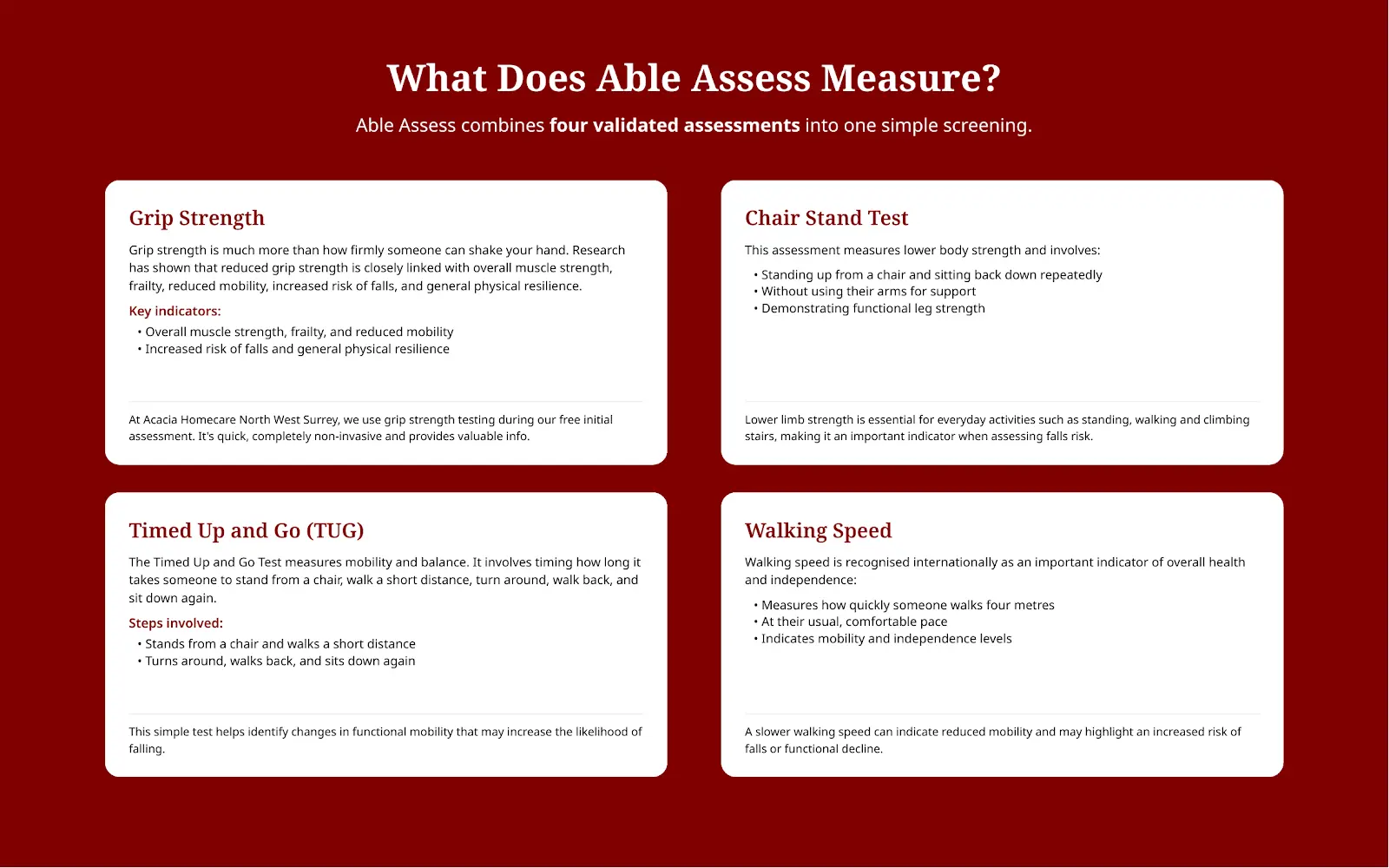
The platform seamlessly captures four vital metrics recommended by the World Guidelines for Falls Prevention (WGFP) and the CDC’s STEADI protocol:
-
Grip Strength: A powerful window into an individual's overall physical resilience and frailty.
-
The 30-Second Chair Stand Test (CST): Measures crucial lower-limb strength and functional endurance.
-
Timed Up and Go (TUG): Evaluates dynamic balance, walking speed, and mobility.
-
4-Meter Gait Speed (4MGS): Gauges walking velocity, a core predictor of a senior's functional reserve.
By combining these four objective data points, the system instantly generates a clear, personalised Falls Risk Summary Report. This eliminates guesswork and gives us a crystal-clear map of exactly where a loved one needs physical support or home modifications.
Our Secret Weapon: Grip Strength (The "New Vital Sign")
While all four tests are vital, our North West Surrey branch is placing a massive focus on Grip Strength as our primary frontline tool.
Why? Because a simple squeeze of a hand can tell us things that blood pressure or a stethoscope simply cannot. Longevity experts and medical researchers now view grip strength as an indispensable biomarker for healthy ageing and biological resilience. Combined with our understanding of a person's daily routine, mobility and home environment, the results help us provide more personalised recommendations.
Reduced muscle mass and strength directly lead to increased frailty and heightened fall risks. Through the Able Assess platform, we map a person's grip strength against a massive normative dataset of their age and sex matched peers, catching signs of physical decline long before they result in an accidental trip or tumble.
What Happens During Your Free NWS Initial Assessment?
We believe proactive care should be accessible to everyone across Spelthorne, Runnymede, Surrey Heath, and Woking. That is why we are offering a Grip Strength and Falls Prevention screening as a completely optional, complimentary add-on during our standard initial free care assessment.
- A Friendly Visit: Our trained North West Surrey care professional visits you or your loved one in the comfort of your home.
- The 5-Minute Screening: If you choose, we’ll use the lightweight, portable Able Care sensor to check grip strength and baseline mobility.
- Instant, Clear Reports: The app automatically compares the scores to objective standards, instantly flagging whether scores are 'Normal' or 'Below Average'.
- Data-Driven Action: If we find that lower-limb strength or grip resilience is dipping, we don't just worry; we act. We use that data to tailor a personalised home care plan, recommend targeted strengthening exercises, or guide you toward local North West Surrey occupational therapy pathways.
[ Free Home Visit ]-->[ 5-Minute Sensor Check ]-->[ Instant Health Report ]-->[ Actionable Care Plan ]
What Happens After the Assessment?
Once the screening is complete, the results are reviewed to build a clearer picture of the individual's current mobility and physical function. The assessment isn't designed to diagnose medical conditions. Instead, it helps identify whether someone may benefit from additional support, such as:
- Falls prevention advice.
- Strength and balance exercises.
- Home safety improvements.
- Further assessment by a healthcare professional.
- Home care support where appropriate.
Because the assessment produces objective results, it also makes it easier to monitor changes over time.
Supporting Independence, Not Taking It Away
Many people worry that asking for help means losing their independence. In reality, identifying small changes early often helps people remain independent for longer. By recognising potential risks before a fall occurs, it's possible to make small adjustments that improve confidence, reduce risk and help older adults continue living safely in the home they love.
Still Worried About Your Parent's Safety?
If you're noticing changes in your parent's mobility or confidence, you don't have to figure everything out on your own. Our friendly team is here to offer practical advice and help you understand what support may be available, with no pressure or obligation.